EDIT: I forgot to mention a paper on Chronic Myeloid Leukemia by Nowak et al. which possibly contradicts the point I'm trying to make. Thanks Heiko Enderling for pointing this out.
EDIT 2: Artem Kaznatcheev has written an excellent blog post arguing for the fact that the above mentioned paper does not contradict my argument.
--------------------------------------------------------------------------------------------------------------------------
The other day I was discussing the merits of mathematical oncology with some colleagues in the collaboratorium (a shared space at the IMO where scientific discussion blend with the smell of espresso) here at IMO. We came to the conclusion that our field of research still lacked that defining publication where the use of mathematical modelling was clearly tied to a clinical change benefiting patients. Or in other words, an instance where mathematical oncology has been proven to make a difference.
Other fields of mathematical biology have already had this pleasure. For example Ronald Ross developed a model of malaria dynamics in the 1910s (known as
the SIR-model), which allowed for a completely new understanding of
of malaria and opened up the field of epidemiology. A more recent example is the use of modelling in the
discovery of the high turnover rates of HIV-particles (http://www.tb.ethz.ch/education/model/HIV_module_1/PerelsonScience1996.pdf).
Given the fact that more and more researchers work in mathematical oncology, isn't it just a matter of time before that landmark publication appears? Actually I think the answer is no.
The reason for me being so pessimistic pertains to the relation between the complexity of the problem and the amount of knowledge that you can fit into a standard publication (journal paper, conference proceeding etc.). Some of you might object and say the way we communicate our results ought to be secondary to the subject at hand, but I would like to argue that the politics and funding structure of science imposes a certain mode of communication that in turn influence how we approach research questions. What biologist can stick to a specific research agenda, work on it for 15+ years, and then publish a monograph on the topic? (The answer to this question is obviously Darwin, whose meticulous work couldn't have been carried out today.)
This is not to say that mathematical modelling does not contribute to our understanding of cancer, but rather that the insights gained from it arrive in smaller chunks and are absorbed by the experimental and clinical community. These insights and novel concepts then shapes their thinking and inspires them to perform new experiments or look at existing data in new ways.
In support of this thesis I would like to cite two ideas that today are ubiquitous in cancer research: networks and intra-tumoral heterogeneity.
The idea that intra-cellular signalling forms a network with feedback loops, crosstalk and robust properties does not emanate from mathematical oncology per se, but rather from complex systems theory and statistical physics. Nevertheless it is now part of the vocabulary of cancer biologists and helps in moving the subject forward.
The concept of tumour evolution was coined by Nowell in 1976, and has been the subject of a large number of mathematical modelling papers. For a long time it was believed that this process was characterised by selective sweeps whereby a single clone would dominate the tumour cell population. However a number of theoretical studies suggested that spatial heterogeneity could give rise to a diversity of subclones, and also that tumour cells with similar phenotypes could harbour different genotypes, both processes contributing to intra-tumoral heterogeneity. When the technology arrived to measure genetic heterogeneity in cancers it was indeed shown that diversity can be large enough to classify different parts of a tumour into different subtypes.
Would these measurements have been made in the absence of theory supporting it? We can never know, but for one thing we can say that the theory facilitated the discovery.
In conclusion I think that mathematical oncology has an important role to play in advancing our knowledge of cancer, but I don't think it will happen through landmark discoveries, rather through piecemeal additions.
Thursday, 20 February 2014

Wednesday, 5 February 2014
Preprint: Evolutionary dynamics of shared niche construction
I have just uploaded a new preprint on arXiv (and bioaRxiv, a new preprint repository for biology) that explores the evolutionary dynamics of shared niche construction.
In the model we assume that the carrying capacity of each species in the population consists of the sum of two parts: an intrinsic part, and a contribution from all species present in the system. If the constructed niche is highly specific, only the first part is included, while a non-specific niche construction corresponds to the second contribution dominating.
Now it turns out that the evolutionary dynamics of the system strongly depends on the specificity: when the carrying capacity is intrinsic, selection is almost exclusively for mutants with higher carrying capacity, while a shared carrying capacity yields selection purely on growth rate.
The below figure illustrates this fact. In the upper panel, where specificity is low, the invasion of a mutant can lead to a decrease in total population size, while in the lower panel, where carrying capacity is intrinsic, each successful invasion increases the total population size.
 Coming from a background in cancer I prefer interpret this result in the context of tumour growth. If you think of different types (or subclones) of cancer cells as being able to withstand and survive different cell densities (i.e. the niche is specific to each subclone) then growth rate of a rare mutant is irrelevant for determining if it spreads in a tumour populated at the maximal cell density of the resident subclone. Only if it can divide and survive at higher densities will it spread and take over the tumour.
The other extreme can be viewed in terms of diffusible factors, such as angiogenetic factors that attract new blood vessels to the growing tumour. The release of a factor benefits all cells (within a reasonable distance) and hence increases the carrying capacity of all subclones. Now a mutant that produces less factors compared to the resident will still receive the benefit, and if it divides faster, will spread in the population. This situation is analogous to the appearance of cheaters in the classical public goods game.
Abstract:
Many species engage in niche construction that ultimately leads to an increase in the carrying capacity of the population. We have investigated how the specificity of this behaviour affects evolutionary dynamics using a set of coupled logistic equations, where the carrying capacity of each genotype consists of two components: an intrinsic part and a contribution from all genotypes present in the population. The relative contribution of the two components is controlled by a specificity parameter $\gamma$, and we show that the ability of a mutant to invade a resident population depends strongly on this parameter. When the carrying capacity is intrinsic, selection is almost exclusively for mutants with higher carrying capacity, while a shared carrying capacity yields selection purely on growth rate. This result has important implications for our understanding of niche construction, in particular the evolutionary dynamics of tumor growth.
In the model we assume that the carrying capacity of each species in the population consists of the sum of two parts: an intrinsic part, and a contribution from all species present in the system. If the constructed niche is highly specific, only the first part is included, while a non-specific niche construction corresponds to the second contribution dominating.
Now it turns out that the evolutionary dynamics of the system strongly depends on the specificity: when the carrying capacity is intrinsic, selection is almost exclusively for mutants with higher carrying capacity, while a shared carrying capacity yields selection purely on growth rate.
The below figure illustrates this fact. In the upper panel, where specificity is low, the invasion of a mutant can lead to a decrease in total population size, while in the lower panel, where carrying capacity is intrinsic, each successful invasion increases the total population size.
The other extreme can be viewed in terms of diffusible factors, such as angiogenetic factors that attract new blood vessels to the growing tumour. The release of a factor benefits all cells (within a reasonable distance) and hence increases the carrying capacity of all subclones. Now a mutant that produces less factors compared to the resident will still receive the benefit, and if it divides faster, will spread in the population. This situation is analogous to the appearance of cheaters in the classical public goods game.
Abstract:
Many species engage in niche construction that ultimately leads to an increase in the carrying capacity of the population. We have investigated how the specificity of this behaviour affects evolutionary dynamics using a set of coupled logistic equations, where the carrying capacity of each genotype consists of two components: an intrinsic part and a contribution from all genotypes present in the population. The relative contribution of the two components is controlled by a specificity parameter $\gamma$, and we show that the ability of a mutant to invade a resident population depends strongly on this parameter. When the carrying capacity is intrinsic, selection is almost exclusively for mutants with higher carrying capacity, while a shared carrying capacity yields selection purely on growth rate. This result has important implications for our understanding of niche construction, in particular the evolutionary dynamics of tumor growth.
Tuesday, 26 November 2013
The 3rd IMO Workshop on Personalized Medicine

Last week I attended an interdisciplinary workshop at Moffitt organised by the Integrated Mathematical Oncology department. It was the third incarnation of the event and this time the focus was on personalised medicine. The structure of the workshop was as follows: the participants were divided into four teams with roughly 10 people in each, containing clinicians, experimentalists and theoreticians. Each team was assigned a specific type of cancer (in line with the knowledge of the clinicians and experimentalists), and the aim was to construct, analyse and present a clinically relevant model, all within 4 days.
I ended up in the "lung team" as one out of three team leaders (the others being Lori Hazlehurst and Ben Creelan), and we decided to work on the problem of drug resistance in stage IV non-small cell lung cancer. Four days is a very short time to achieve the goals described above, and the workshop was an intense experience. Reaching across disciplines, trying to talk the same language, define a reasonable question, formulate a mathematical model, simulate it, get nice graphical results and create a nice looking presentation. Our team probably averaged 12 hours of work per day, and the last evening we didn't get to bed until 3 am. As tough as it might seem it was also rewarding, and I learned a lot.
In contrast to most academic events there was also a competitive element. Three external judges picked a winning team based on a number of criteria (originality, success, data utilisation etc.), and the winning team leaders were awarded a $50K pilot grant. The idea being that the project started at the workshop will develop into a full scale interdisciplinary research project.
All four teams (blood, lung, urogenital, breast) did a great job, but apparently the judges thought that our team was the most accomplished and awarded us the grant. What up to then had seemed abstract and remote all of a sudden became very real, and I'm now looking forward to spending the grant on refining and validating our model.


Friday, 1 November 2013
Big Data Business
In a talk given at the Royal Society on the origin of life, John Maynard Smith noted that while the 19th century had been the century of energy, in which science and engineering were concerned with transformning energy from one form to another (chemical to mechanical as in a steam engine or mechanical to elecrical as in a dynamo), the 20th century was about information, and in particular the transformation of information. In biology we have learned that our genes are written in a genetic code, that is being transmitted, translated and transcribed, and high-energy physics is to a large extent focused on interpreting the massive amounts of information that is being produced in particle accelerators. Today information technology is a major industry, and it is possible to make a fortune on simply transforming one form of information into another more useful shape.
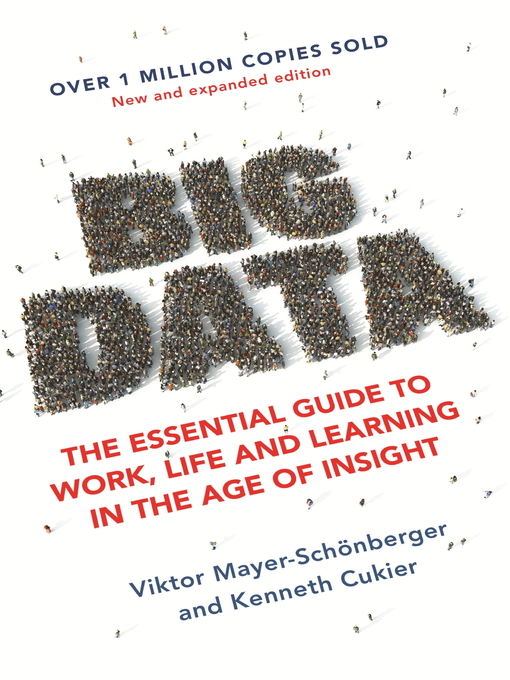
The latter activity is the topic of the book Big Data: a revolution that will transform how we live, work and think by Viktor Mayer-Schönberger and Kenneth Cukier. In it they explore the consequences of our ever increasing ability to gather, store and process data, and focus in particular on the implications it has for business. They show how IT-giants such as Google and Amazon have gotten ahead in the game by relying on the power of data, and have developed clever ways of acquiring and utilising it. For example Google has built a spell-checking algorithm from all the billions of misspelled search queries that they have amassed. In a similar way Google have also constructed a translation algorithm based on millions of webpages that happen to exist in multiple languages.
The data is messy, but the shear volume overcomes the problems. This represents, they authors claim, the opposite to the traditional approach to acquiring knowledge, i.e. careful data acquisition and analysis, studying only a subset of the totality of data. Big data is taking all possible information into account, or N = all, in the words of the authors.
A more creative and surprising (at least to me) example of big data, which highlights the potential of data transformation, is the ability to predict local economic growth and unemployment figures from analysing geo-location data from gps devices. The book is full of such examples, which although interesting become slightly tedious after a while. More importantly perhaps they made me conscious of all the different ways in which we give away our personal information in exchange for "free services" offered by big data companies. The company performing the above mentioned predictions gathers its data from a "free" gps app.
For the single user, Twitter represents a way to communicate and connect in a rapid and free manner, but to the company the tweets represent datafied moods and feelings of millions of people that are updated every instant. Twitter thus has direct and quantifiable access to millions of peoples minds in real-time. It is therefore no surprise that data from Twitter can be used in order to predict everything from box office sales to election results.
The book is mainly aimed at business people, but still touches on the implications for science and society at large. One recurring topic is that we in the future will move away from causation and rely more on correlation in our attempts to understand the world. This might be so, but, as the authors rightly point out, we still need theory to place the data and the conclusions drawn from it in a framework of understanding.
Despite its brevity (just under 200 pages excluding references and notes) it is a bit repetitive, and a few factual errors also detract from its appeal (no, Steve Jobs did not survive longer because he had his genome sequenced, experiments are not often complicated and unethical, and yes it was possible to determine ones position prior to gps-technology, using for example a chronometer and sextant.)
In any case I would recommend the book to those who are curious about how information gathering and analysis is changing our society and how business is done, but wouldn't recommend to those that are hoping for a more scientific or philosophical view on Big Data.
The latter activity is the topic of the book Big Data: a revolution that will transform how we live, work and think by Viktor Mayer-Schönberger and Kenneth Cukier. In it they explore the consequences of our ever increasing ability to gather, store and process data, and focus in particular on the implications it has for business. They show how IT-giants such as Google and Amazon have gotten ahead in the game by relying on the power of data, and have developed clever ways of acquiring and utilising it. For example Google has built a spell-checking algorithm from all the billions of misspelled search queries that they have amassed. In a similar way Google have also constructed a translation algorithm based on millions of webpages that happen to exist in multiple languages.
The data is messy, but the shear volume overcomes the problems. This represents, they authors claim, the opposite to the traditional approach to acquiring knowledge, i.e. careful data acquisition and analysis, studying only a subset of the totality of data. Big data is taking all possible information into account, or N = all, in the words of the authors.
A more creative and surprising (at least to me) example of big data, which highlights the potential of data transformation, is the ability to predict local economic growth and unemployment figures from analysing geo-location data from gps devices. The book is full of such examples, which although interesting become slightly tedious after a while. More importantly perhaps they made me conscious of all the different ways in which we give away our personal information in exchange for "free services" offered by big data companies. The company performing the above mentioned predictions gathers its data from a "free" gps app.
For the single user, Twitter represents a way to communicate and connect in a rapid and free manner, but to the company the tweets represent datafied moods and feelings of millions of people that are updated every instant. Twitter thus has direct and quantifiable access to millions of peoples minds in real-time. It is therefore no surprise that data from Twitter can be used in order to predict everything from box office sales to election results.
The book is mainly aimed at business people, but still touches on the implications for science and society at large. One recurring topic is that we in the future will move away from causation and rely more on correlation in our attempts to understand the world. This might be so, but, as the authors rightly point out, we still need theory to place the data and the conclusions drawn from it in a framework of understanding.
Despite its brevity (just under 200 pages excluding references and notes) it is a bit repetitive, and a few factual errors also detract from its appeal (no, Steve Jobs did not survive longer because he had his genome sequenced, experiments are not often complicated and unethical, and yes it was possible to determine ones position prior to gps-technology, using for example a chronometer and sextant.)
In any case I would recommend the book to those who are curious about how information gathering and analysis is changing our society and how business is done, but wouldn't recommend to those that are hoping for a more scientific or philosophical view on Big Data.
Monday, 21 October 2013
Moffitt Cancer Center
Today is my first official day on my new position as a research scientist in the Integrated Mathematical Oncology group at Moffitt Cancer Center. I'll be working with Alexander 'Sandy' Anderson, my former PhD-supervisor, who is now heading the IMO.

Apart from new hire orientation and other exciting administrative stuff I'm currently working on a project related to evolution of resistance. The plan is to look at how drug specificity and fitness landscape topography influences the evolution of resistance. Hopefully I'll have more to say in a not too distant future.
Apart from new hire orientation and other exciting administrative stuff I'm currently working on a project related to evolution of resistance. The plan is to look at how drug specificity and fitness landscape topography influences the evolution of resistance. Hopefully I'll have more to say in a not too distant future.
Wednesday, 16 October 2013
Robust science
As a part of my book project on complexity I have been reading William Wimsatt's 'Re-engineering philosophy for limited beings', which in essence is a subset of his papers published in the last 30 years merged into a coherent whole.

The main purpose of the book is to introduce a new philosophy of science, which accounts for our limitations as human beings. Traditionally philosophy of science has assumed that scientists are perfect beings, having infinite computational power and never making any mistakes, and Wimsatt's aim is to replace this view with one in which scientists are fallible and error-prone. Now if this is the case, how do we formulate a scientific method that accounts for and embraces these limitations?
The greater part of the book is devoted to answering this and related questions, and I will here only mention one aspect that I found particularly intriguing.
The traditional account of a scientific theory is a set of assumptions or axioms together with some rules of deduction that dictate how novel and true statements can be produced. Assuming that the axioms are true we can generate a possibly infinite set of true statements all connected somehow by the rules of deduction. The picture is that of a network, where true statements are nodes and deductions form the links.
In reality however scientific statements are rarely held together by truth preserving rules of inference, but rather by experimental data, hand-waving analytical results and results from models. All of these may contain flaws, which run the risk of undermining the theory. If an experimental result turn out to be wrong for some reason, then the corresponding link in the network breaks, and if the link points to a statement with only one link, then that statement has to go.
How then should we deal with this situation? Wimsatt's answer is that we already are dealing with it by making robust inferences. In general we don't trust the results of single model, but instead require some independent verification. And if two different models provide the same answer then it's more likely to be accurate. And the more links that are pointing towards a statement the more likely it is to be true. Even if some of the experimental results or conclusions made from models turn out to be flawed the statement still stands.
I think this network analogy is useful way of illustrating the how scientific knowledge is accumulated and has certainly helped me in thinking about my work.
The main purpose of the book is to introduce a new philosophy of science, which accounts for our limitations as human beings. Traditionally philosophy of science has assumed that scientists are perfect beings, having infinite computational power and never making any mistakes, and Wimsatt's aim is to replace this view with one in which scientists are fallible and error-prone. Now if this is the case, how do we formulate a scientific method that accounts for and embraces these limitations?
The greater part of the book is devoted to answering this and related questions, and I will here only mention one aspect that I found particularly intriguing.
The traditional account of a scientific theory is a set of assumptions or axioms together with some rules of deduction that dictate how novel and true statements can be produced. Assuming that the axioms are true we can generate a possibly infinite set of true statements all connected somehow by the rules of deduction. The picture is that of a network, where true statements are nodes and deductions form the links.
In reality however scientific statements are rarely held together by truth preserving rules of inference, but rather by experimental data, hand-waving analytical results and results from models. All of these may contain flaws, which run the risk of undermining the theory. If an experimental result turn out to be wrong for some reason, then the corresponding link in the network breaks, and if the link points to a statement with only one link, then that statement has to go.
How then should we deal with this situation? Wimsatt's answer is that we already are dealing with it by making robust inferences. In general we don't trust the results of single model, but instead require some independent verification. And if two different models provide the same answer then it's more likely to be accurate. And the more links that are pointing towards a statement the more likely it is to be true. Even if some of the experimental results or conclusions made from models turn out to be flawed the statement still stands.
I think this network analogy is useful way of illustrating the how scientific knowledge is accumulated and has certainly helped me in thinking about my work.
Thursday, 10 October 2013
Comparative drug pair screening across multiple glioblastoma cell lines reveals novel drug-drug interactions
I'm the co-author of a newly published paper on drug-pair screening on glioblastoma (brain tumour) cell lines. The bulk of the work was carried out by Linnéa Schmidt in the Nelander lab at Gothenburg University. Below is the abstract, and the full paper can be found here.
Abstract
Background
Glioblastoma multiforme (GBM) is the most aggressive brain tumor in
adults, and despite state-of-the-art treatment, survival
remains poor and novel therapeutics are sorely
needed. The aim of the present study was to identify new synergistic
drug pairs
for GBM. In addition, we aimed to explore
differences in drug-drug interactions across multiple GBM-derived cell
cultures
and predict such differences by use of
transcriptional biomarkers.
Methods We performed a
screen in which we quantified drug-drug interactions for 465 drug pairs
in each of the 5 GBM cell lines U87MG,
U343MG, U373MG, A172, and T98G. Selected
interactions were further tested using isobole-based analysis and
validated in 5
glioma-initiating cell cultures. Furthermore,
drug interactions were predicted using microarray-based transcriptional
profiling
in combination with statistical modeling.
Results Of the 5 × 465
drug pairs, we could define a subset of drug pairs with strong
interaction in both standard cell lines and
glioma-initiating cell cultures. In particular, a
subset of pairs involving the pharmaceutical compounds rimcazole,
sertraline,
pterostilbene, and gefitinib showed a strong
interaction in a majority of the cell cultures tested. Statistical
modeling of
microarray and interaction data using sparse
canonical correlation analysis revealed several predictive biomarkers,
which
we propose could be of importance in regulating
drug pair responses.
Conclusion We identify novel candidate drug pairs for GBM and suggest possibilities to prospectively use transcriptional biomarkers
to predict drug interactions in individual cases.
Subscribe to:
Posts (Atom)